
What is Dust Testing?
What is Dust Testing?
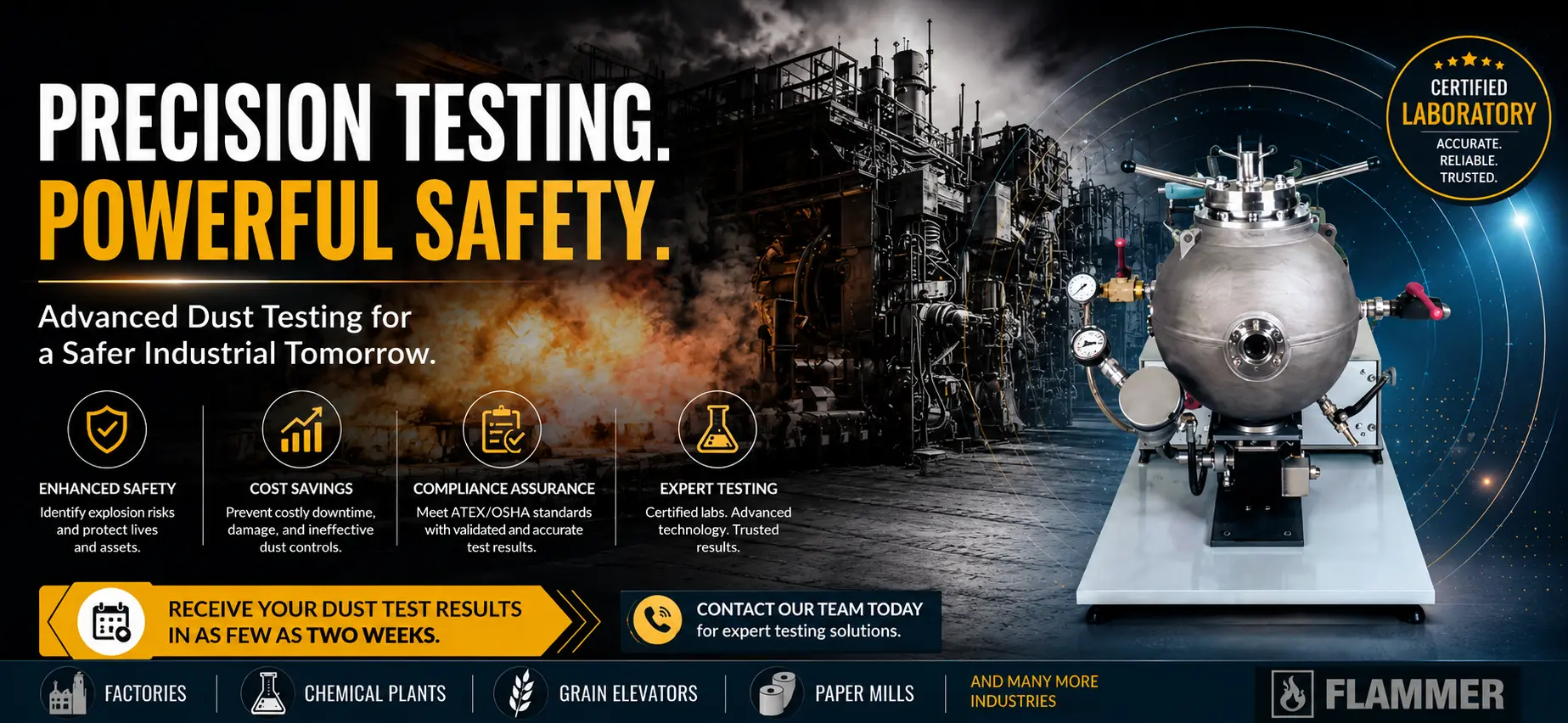
Dust Testing is the scientific process of measuring how explosive or combustible the dust particles in your facility actually are. Most people do not think of dust as dangerous — but sugar, wood, grain, and certain metals can all become serious explosion hazards under the right conditions.
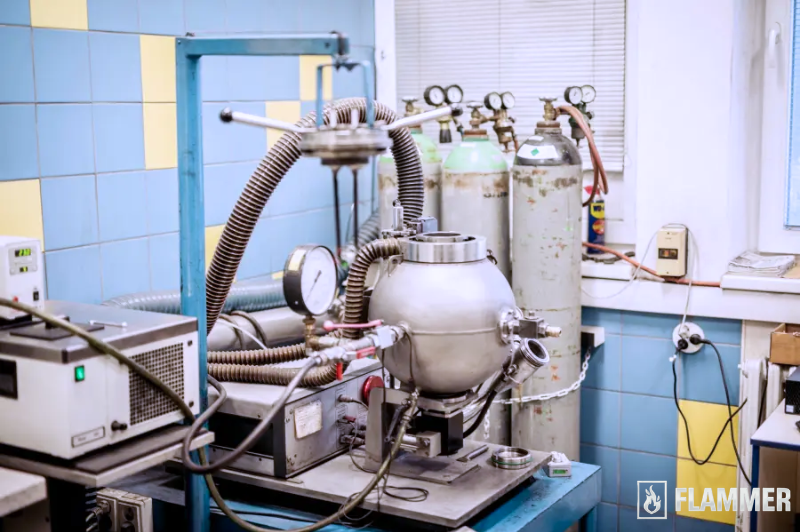
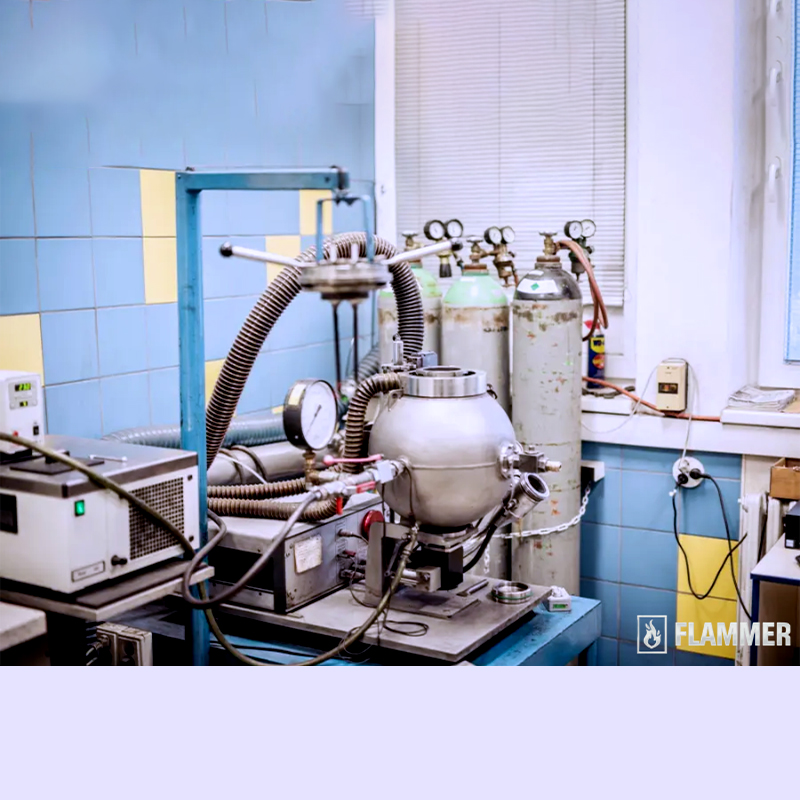
Flammer Technologies tests dust samples from factories, chemical plants, grain elevators, paper mills, and more — giving you real, measured data about the explosibility of your facility’s dust. Testing is carried out using a calibrated 20-liter chamber that delivers accurate results representing actual real-world, industrial-scale conditions. As a trusted Dust Testing service provider in India, we deliver accurate testing, proper lab practices, and reports that are clear and easy to act on.
Key Testing Parameters
| Code | Parameter | Description |
|---|---|---|
| Kst | Deflagration Index | Measures the rate of pressure rise during a dust explosion. Classifies dust into St-1, St-2, or St-3 hazard classes. |
| Pmax | Maximum Explosion Pressure | The peak pressure generated during a dust explosion. Critical for designing containment structures and suppression systems. |
| MIE | Minimum Ignition Energy | The lowest energy spark that can ignite a dust cloud. Guides electrostatic and electrical equipment safety measures. |
| MIT | Minimum Ignition Temperature | Temperature at which a dust cloud or layer ignites. Essential for process temperature controls and hot surface safety. |
Why Your Plant Needs Professional Dust Testing Services
Before you can protect your plant from an explosion, you have to know exactly what you are dealing with. Dust Testing is the only way to understand how dangerous your raw materials really are. Many people don’t realize that even sugar, wood, or certain metals can turn into a bomb under the right conditions. By performing detailed dust particle testing, we can identify the specific risks in your facility.
At Flammer Technologies, we carry out detailed dust particle testing to measure important values like Kst, Pmax, MIE, and MIT. These results clearly show the level of Dust Combustibility and help industries plan proper protection systems. As one of the dependable Dust Testing service providers in India, we focus on accurate procedures, proper lab practices, and clear reporting.
Dust Testing Services for Practical and Reliable Safety Planning
Good safety planning always starts with proper combustible Dust Testing. Without knowing the flammable properties of dust, it becomes difficult to design explosion protection systems correctly. Our Dust flammability testing helps industries identify ignition sensitivity and understand the real level of risk inside their facility so that you can select the explosion protection systems correctly.
Flammer Technologies is recognized among the top Dust Testing suppliers in India because we combine high-tech lab equipment with real-world engineering experience. We work closely with clients from different sectors to ensure proper sample handling and timely analysis. We believe testing should not just give numbers, but meaningful information that industries can actually use.
Benefits of Dust Testing
Every successful business puts safety first — and dust testing is one of the most direct ways to protect it. Once you know the explosive properties of the dust in your facility — like Minimum Ignition Temperature or Energy Sensitivity — you have the knowledge to act before something goes wrong rather than after. That kind of preparation saves lives. It also keeps your equipment running and your facility standing.
Yes, dust testing does involve an upfront cost, but think about the long-term savings. An industrial accident brings equipment damage, unplanned downtime, legal exposure, and regulatory fines. Dust testing is the kind of investment that pays for itself many times over — by helping you avoid the far bigger costs that come when something goes wrong.
- FInd hidden explosion risks — sugar, wood, grain, and metals are all capable of igniting
- Build protection systems on real measured data, not assumptions
- Stay compliant with EN 14491, NFPA 68, and ATEX directives
- Lower long-term financial exposure from accidents, downtime, and legal liability
- Strengthen a culture of safety that runs through your whole organization
Testing Process
| Step 01 |
Sample Collection & Submission |
Collect representative dust samples from your facility — from collection systems, process areas, or accumulation points. Samples are shipped to our lab in Vadodara. |
| Step 02 |
Sample Preparation & Conditioning |
Samples are dried, sieved, and prepared to standardized particle size distributions ensuring results accurately represent worst-case conditions in your plant. |
| Step 03 | 20-Liter Sphere Testing | Tests are conducted in our calibrated 20-liter spherical explosion chamber — the internationally recognized standard providing accurate measurements for Kst, Pmax, MIE, and MIT. |
| Step 04 | Analysis & Certified Report | Results are analyzed by certified engineers and compiled into a comprehensive, audit-ready report with dust hazard classification and compliance documentation. |
| Step 05 |
Protection System Recommendations |
Our team reviews findings with you and recommends appropriate explosion protection measures — venting, suppression, isolation, or containment — based on your specific test data. |
